.jpeg)
Exhibition Reviews
Asam Di Gunung, Garam di Laut: A Kain of Marriage (2024)
Reading Time: 3 minutes 30 s
Updated on: 02/04/24
“Asam di gunung, garam di laut bertemu dalam satu belanga”, a Malay proverb directly translating to "tamarind in the mountains, salt in the sea meet in one pot," suggests that distant elements can converge as one, symbolising how individuals of different backgrounds can harmoniously unite and thrive in society. This proverb serves as the thematic inspiration for the exhibition, Asam Di Gunung, Garam di Laut: A Kain of Marriage, curated by Tony Surgiata at aNERDgallery as part of Singapore Art Week 2024.
Surgiata has curated a collection that teases this concept, inviting mixed-race and textile artists including Agnes Christina, Ass and Dam collective (comprising Nila Choo, Tamarra, Wong Mei Sheong), Brahma Tirta Sari (comprising Agus Ismoyo, Nia Filam), Carolyn Oei and Kar-men Cheng. These artists have created works centred on the theme of hybridity, and the navigating of tensions that occur in everyday spaces, which is much relevant within the context of multicultural Singapore.
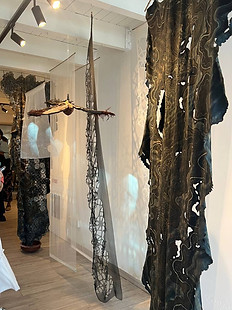
aNERDgallery is located on a quaint street of shophouses in Jalan Besar, a culturally rich and diverse area since the late 1900s, which sets the mood for the exhibition prior to entering. The smell of incense fills the nostrils, accompanied by the sight of a row of deconstructed batik cloth hanging from the ceiling. The work, titled “Father Sky & Mother Earth,” created by Brahma Tirta Sari (Agus Ismoyo and Nia Filam) dominates the entrance and greets the visitors first. Described as the tangible evidence of a collaboration of reciprocal relationships, this installation embodies the minds of two artists of different arts and cultural backgrounds: Ismoyo, Indonesian, and Nia Filam, American.
They approached creating this work through an Indonesian philosophical concept called Tribawana (or “Three Worlds”), wherein individuals strive to find balance within themselves, nature, and their ancestors. Building upon this concept, the idea of “Growth in Rootedness”, which draws inspiration from the regeneration of trees, is evident in the deconstructed batik cloths. They are stretched out like drying animal skin, bearing burnt holes in the entirety of it, akin to the dried leaves fallen from the branches of trees. Bowls filled with water and ceremonial flowers placed beneath the batik cloth seem to act as offerings to nature, aligning with the principles of Tribawana. A video of a man stepping onto mud is projected onto layers of plain white cloth in the centre of the installation. It resembles a dream, with the cloth gently stirred by a fan breeze, offering a calming effect to viewers.
A notable feature of this installation is a cylindrical-shaped batik cloth, resembling a fishing net, purposefully positioned in front of the hanging cloths. Surgiata explained that it symbolises Mother Earth looking after us humans, as intended by the artists. Surgiata's deliberate decision to position this installation at the entrance is strategic as it immediately introduces the viewers to the theme of hybridity on a positive note. It immerses viewers in the artwork as they navigate through it to enter the main space where the other works are located.
The main space of the gallery, though small, envelopes viewers with a sense of homeliness with its warm lighting and the rather casual placement of the works. Four artworks are tucked into each wall, allowing ample space for easy manoeuvring. One of the artworks immediately captures the viewer’s attention due to the array of phallic and sensual-looking fabrics.
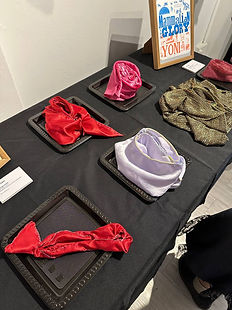
Ass & Dam is a collective comprising Nila Choo, Tamarra, and Wong Mei Sheong. The three artists have created a body of work that delves into intersections of gender, tradition, and identity through textiles. Titled ‘What is a (Wo)man?’, the work features fabrics of various textures and colours shaped into vulvas and penises. They are displayed on paper plates atop a table draped in black cloth, with two works suspended above the table. Just beside, are two mannequins of the typical male and female body made of textile. They are residues of a performance art work. Accompanying the display is a paper card with the prompt ‘Touch me gently and ponder: what makes a (wo)man?’, inviting viewers to engage with the textile art.
Drawing inspiration from Judy Chicago's iconic artwork, The Dinner Party, ‘What is a (Wo)man?’ seeks to deconstruct conventional understandings of women’s anatomy, while introducing new perspectives on femininity and gender norms. By posing their title as a question, with the letters ‘W’ and ‘O’ separated from the word ‘woman’, the collective echoes Wong Mei's personal belief that gender should not be put into distinct categories, as everyone embodies both masculine and feminine aspects. Ultimately, the artwork challenges viewers to reconsider their perceptions of womanhood and confronts societal norms regarding gender identity.
These two artworks, despite addressing different issues or topics on hybridity, speak to each other with their innovative and subversive use of batik. The exhibition successfully prompts the viewers to think about hybridity from different perspectives in our daily lives. The small exhibition space has also allowed for it to be an intimate environment, encouraging conversation and reflection. The works featured in this exhibition review have inspired me to delve further into my traditional practices and terminologies that I am familiar with but have not thought deeper into. While creating artworks that are new and unique is vital in the contemporary art scene, I believe my works should prioritise looking into traditional beliefs or practices. In particular, the Malay world is rich in this aspect but often overlooked in this bubble we live in; Singapore.
.jpeg)
.jpeg)


.jpeg)
.jpeg)